Lera Auerbach, writer, composer, and artist, reads an excerpt from her book "Mirror," published by Virgola Press.
Russian-American Cultural Center presents:
Lera Auerbach, writer, composer, and artist, reads an excerpt from her book "Mirror," published by Virgola Press.
Event Date: Wednesday, September 30, 2026. 5:00 pm – 6:30 pm Event Venue: Yorkville Library, Meeting Room 222 E. 79th Street, New York, NY 10075
Event Date:
Event Date: Wednesday, September 30, 2026. 5:00 pm – 6:30 pm Event Venue: Yorkville Library, Meeting Room 222 E. 79th Street, New York, NY 10075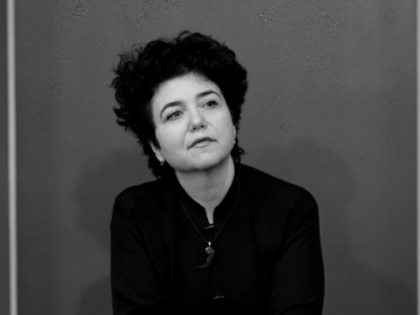
A genre-defying Russian-language novel in reflections, where memory transcends time and prose moves with the architecture of music. New York / Berlin 2026
Virgola Press announces the publication of Mirror (Зеркало), a new Russian-language novel by Lera Auerbach, a writer whose prose carries the precision of music, the freedom of poetry, and a restless inquiry into memory, childhood, time, and the inward life.
Subtitled A Novel in Reflections, Mirror is not a conventional novel. It is diary and monodrama, confession and labyrinth, musical score and mythic theatre. Composed in twenty-four preludes and twenty-four postludes, with trios, mirrored returns, inversions, and a final coda, the book transforms literary form into an act of reflection. One part answers another; one image reappears altered; one memory casts a shadow across another. The result is a work in which prose behaves like music.
From its opening pages, Mirror announces its resistance to classification. Auerbach has written a work whose form is inseparable from its meaning: a self-portrait fractured through memory, childhood, exile, myth, grief, wit, silence, and sound. The book contains two textual lines. The first is the world seen through the eyes of a child; intertwined with it is a world of mythological archetypes: Adam and Eve, the Wanderer who is trying to understand what happiness is, and the wolf-boy Mowgli searching for love. In this world there is Lady Separation, and the god Pan playing his flute. Set against it is the world of an adult who feels the of something very important: something once understood and felt in childhood, something so difficult to grasp and express in words. At the center of Mirror is the question that recurs like a musical leitmotif: What remains? What remains after childhood has vanished? What remains after a country disappears from the map? What remains after language fails, after family silence, after the self sees its reflection and no longer recognizes the original? The mirror is not merely an object but a metaphysical instrument: double glass, distorted surface, stage, wound, and portal. The novel begins with the child staring into the mirror, eye to eye with her own reflection, trying to understand who chose this face, this body, these eyes. That gaze opens into an entire theatre of inner figures: Pan and the Demon, Eve and Adam, Mowgli and the Wanderer, Don Quixote and the Satyr, the Cheshire Cat and Lady Separation. The book moves through the golden realm of childhood, the river of losses, the thread of Ariadne, the return journey, and finally into a coda of poems from the notebook of the Wanderer, as if prose itself must eventually dissolve into music and poetry.
The literary voices already gathered around Mirror recognize its unusual force.
Vladimir Gandelsman writes: “This is a book of rare inward freedom and spiritual lucidity, in which childhood, music, the world, and the word are gathered into a profound knowledge of the human soul.” In his fuller reflection, Gandelsman describes Mirror as a work in which childhood, music, myth, and language gather into a profound vision of what it means to be human.
Alexander Genis places the novel in a rare category, where language and music arise from the same impulse: “Some writers begin with painting, others with music. Lera Auerbach’s Mirror belongs to that rare order of books in which language and music seem born of the same impulse. Her magnum opus can scarcely be called prose at all. It is a poetic work of a singular kind: delicate, elegant, and seemingly effortless in movement, yet entirely lucid in its intricate weave of motifs, a coming-of-age novel for a solo virtuoso.”
Solomon Volkov emphasizes the originality of the book’s architecture: “Mirror is a novel remarkable alike in conception and in form. Its structure, composed of twenty-four preludes and twenty-four postludes, turns form itself into a mirror, so that each part reflects the other and acquires new meaning. With exceptional virtuosity, Auerbach brings to prose the precision of structure and subtlety of nuance more often associated with music. At the heart of the novel lie childhood and memory, that vanishing substance of life which, despite loss, continues to shine through language.” Born in Chelyabinsk in the Ural Mountains of the former Soviet Union, Auerbach left the collapsing Soviet world as a teenager and built a life across languages, countries, and artistic forms. Mirror carries that biography without reducing itself to autobiography. The book is not a memoir. It is the inner archaeology of a consciousness: Russian childhood, Jewish memory, music lessons, mythic imagination, emigration, estrangement, artistic vocation, and the stubborn survival of the inward life. Few contemporary writers are as naturally equipped to create a novel in this form. Auerbach’s literary imagination has always moved between poetry, philosophy, music, theatre, and image. In Mirror, those worlds do not merely coexist. They fuse. The page becomes a stage; memory becomes orchestration; childhood becomes a realm of terror and radiance; language becomes a mirror that both reveals and deceives. The novel’s final movement offers the book’s most haunting claim: words end, but music remains. Mirror is a literary work about the limits of literature, a prose work haunted by what prose cannot fully contain.
Lera Auerbach is a poet and writer whose work brings literature and music into a single artistic vision. Writing in both English and Russian, she has created a body of work distinguished by formal freedom, philosophical depth, and a voice unmistakably her own. Her writing returns to memory, time, loss, exile, childhood, and the inward life with rare intensity and precision. In her work, personal experience opens onto the deeper continuities of culture and consciousness. Living between New York and Vienna, Auerbach occupies a singular place in world culture. Across disciplines, her work asks how beauty, memory, rupture, wit, and imagination survive history.
 The Russian-American Cultural Center program was made possible by part with public funds from the New York City Department of Cultural Affairs in Partnership with the City Council, New York State Council on the Arts with the support of the Office of the Governor and the New York State Legislature, Cojeco and Tianaderrah Foundation.